WeatherForensics
Past Weather. Present Impact. AI-Ready Intelligence
WeatherForensics DaaS provides comprehensive historical weather data, including standard conditions and severe weather events, sourced from authoritative meteorological datasets.
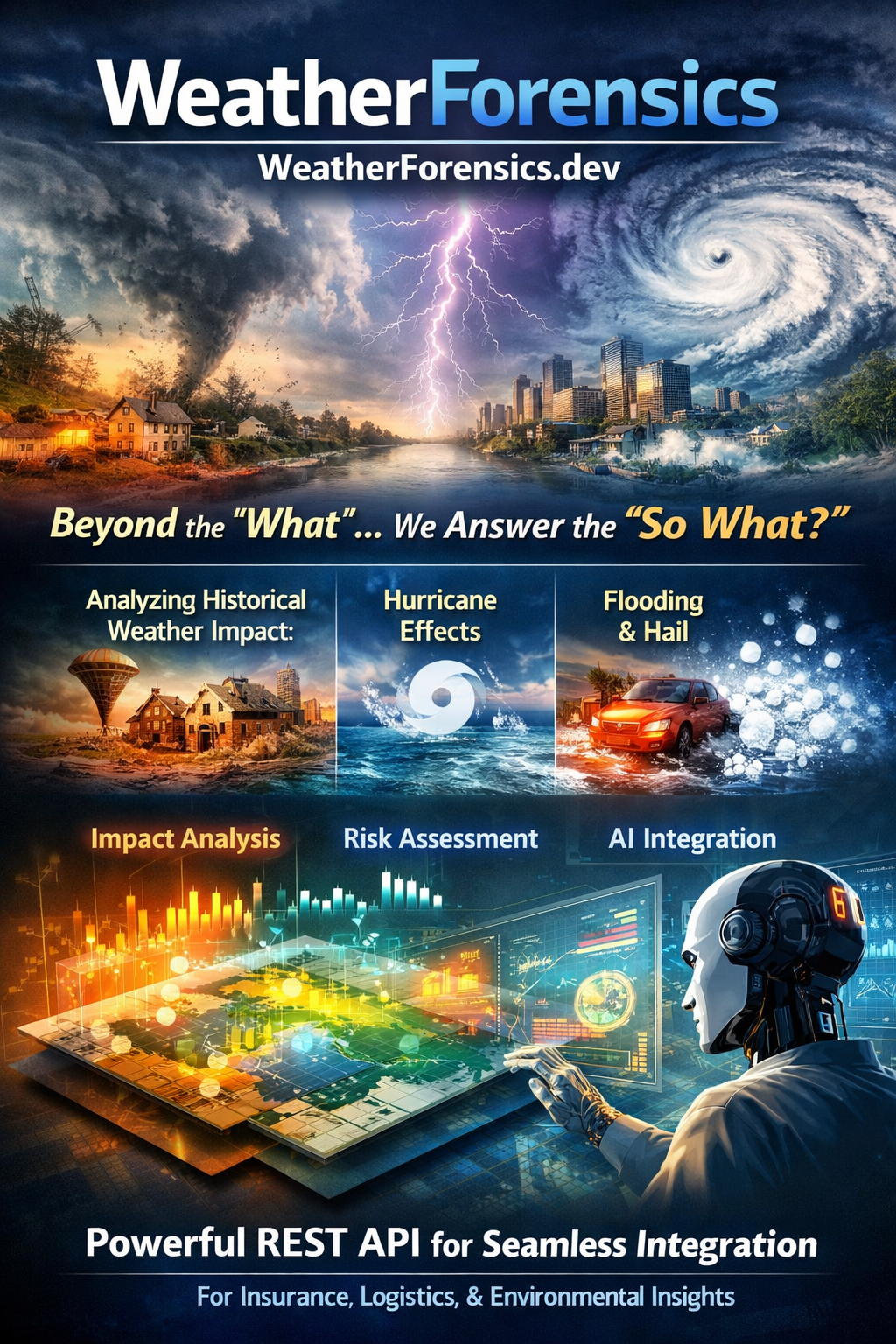
While most services focus on the "what," we focus on the "so what?" Our proprietary engine doesn't just return temperature and wind speed; it calculates the localized impact of historical weather events—ranging from localized tornadoes to regional hurricanes—at a specific coordinate and datetime.
Built for the future of automation, WeatherForensics is fully compatible with the Model Context Protocol (MCP). This allows Artificial Intelligence (AI) agents to instantly retrieve and reason over historical weather patterns, providing your LLM-driven applications with the ground-truth data they need for insurance claims, logistics forensics, or environmental research.
WeatherForensics also offers Representational State Transfer (REST) API endpoints. Seamlessly integrate our powerful API into your applications to enhance your data-driven decisions with weather data contextualized for your specific location and temporal requirements.
Get Started with MCP View REST API Docs REST API Interactive Demo MCP Interactive Demo AI Weather App